
Innovative solutions for security
Discover essential enterprise network design best practices for modern campus environments. Explore hierarchical architecture, core and distribution switching, VLAN segmentation, routing, high availability, cybersecurity, enterprise Wi-Fi, network automat
Enterprise Network Design: Best Practices for Modern Campus Networks
Building Secure, Scalable, Resilient, and High-Performance Enterprise Networks
Modern enterprise campus networks are the foundation of business communication, digital collaboration, cloud connectivity, and critical application delivery.
As organizations adopt cloud applications, wireless mobility, IoT devices, unified communications, and hybrid working environments, traditional network architectures must evolve to support greater performance, security, scalability, and operational resilience.
At Pruthvija Technologies, we emphasize structured network architecture, secure connectivity, infrastructure redundancy, and operational simplicity when designing enterprise campus networks.
This article explores essential design principles, recommended architectures, and practical implementation considerations for building modern enterprise networks.
1. Understand Business and Technical Requirements
Successful enterprise network design begins with a comprehensive assessment of organizational requirements.
Before selecting switches, routers, wireless controllers, or security platforms, network architects should evaluate:
-
Number of users, devices, and network locations
-
Business-critical applications and bandwidth requirements
-
Existing LAN, WAN, and wireless infrastructure
-
Voice, video, CCTV, IoT, and operational technology requirements
-
Network security and segmentation policies
-
Cloud and data center connectivity
-
Redundancy and business continuity objectives
-
Expected infrastructure growth
-
Monitoring, automation, and management requirements
Best practice: Develop a documented requirements assessment and network design baseline before proceeding with architecture and hardware selection.
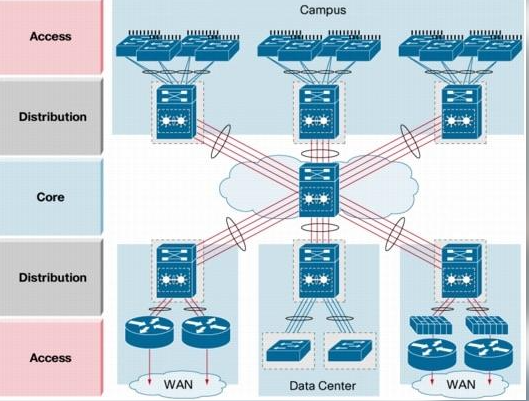
2. Adopt a Hierarchical Campus Network Architecture
A hierarchical network architecture improves scalability, fault isolation, performance, and operational manageability.
Traditional enterprise campus networks commonly use three functional layers.
Core Layer
The core layer provides high-speed and resilient connectivity between distribution blocks, enterprise services, data centers, and WAN connectivity.
Design considerations include:
-
High-performance Layer 3 switching
-
Redundant core infrastructure
-
Fast routing convergence
-
High-bandwidth uplinks
-
Minimal unnecessary policy complexity
-
Resilient interconnection between network domains
Distribution Layer
The distribution layer aggregates access switches and establishes network policy boundaries.
Typical functions include:
-
Layer 3 routing and VLAN gateways
-
Access control and segmentation
-
Route summarization where appropriate
-
Quality of Service policies
-
Redundant uplink connectivity
-
Network fault-domain isolation
Access Layer
The access layer connects enterprise endpoints and infrastructure devices.
Typical devices include:
-
User computers and laptops
-
IP phones
-
Wireless access points
-
CCTV cameras
-
Printers
-
IoT and operational devices
Access-layer design should consider PoE requirements, port capacity, authentication, endpoint segmentation, and uplink resilience.
Two-Tier vs. Three-Tier Architecture
For smaller or medium-sized campus environments, a collapsed-core architecture can combine core and distribution functions.
Larger enterprise campuses may benefit from separate core, distribution, and access layers.
Best practice: Select the architecture based on network scale, application requirements, availability objectives, and operational complexity rather than assuming that every campus requires three layers.
3. Design VLANs, IP Addressing, and Network Segmentation
A structured VLAN and IP addressing strategy improves security, troubleshooting, and network manageability.
Typical enterprise network segments include:
| Network Segment | Purpose |
|---|---|
| Corporate Users | Employee devices and workstations |
| Corporate Wireless | Enterprise wireless clients |
| Guest Wireless | Internet-only guest access |
| Voice | IP telephony infrastructure |
| CCTV | Surveillance cameras and recording systems |
| IoT / OT | Smart devices and operational systems |
| Management | Network equipment administration |
| Servers | Enterprise application infrastructure |
VLANs create Layer 2 broadcast domains, but they do not independently enforce security between routed networks.
Use appropriate Layer 3 access controls, firewalls, VRFs, or other segmentation mechanisms to enforce communication policies.
Recommended practices include:
-
Define a consistent VLAN naming convention
-
Maintain structured IP addressing documentation
-
Minimize unnecessary VLAN extension
-
Use DHCP relay where required
-
Restrict unused switch ports
-
Separate management traffic from user traffic
-
Apply least-privilege access policies
-
Use VRFs when stronger routing-domain separation is required
Best practice: Design segmentation according to security and application requirements rather than simply grouping devices by physical location.
4. Implement Resilient Routing and Switching
Network availability is critical for enterprise applications and business operations.
A resilient campus design should eliminate avoidable single points of failure.
Recommended Technologies
OSPF: A commonly used interior gateway protocol for dynamic routing in enterprise networks.
BGP: Suitable for policy-driven routing, WAN connectivity, and selected large-scale or fabric architectures.
ECMP: Enables traffic forwarding across multiple equal-cost Layer 3 paths.
LACP: Supports link aggregation between compatible devices and logical switching systems.
HSRP / VRRP: Provides default gateway redundancy in applicable Layer 2 gateway architectures.
STP / RSTP / MSTP: Helps prevent Layer 2 forwarding loops in traditional switched networks.
Switch Stacking / Virtual Chassis: Allows supported physical switches to operate as a logical switching system.
Important Design Consideration
A single access switch cannot ordinarily form one standard LACP port-channel across two completely independent distribution switches.
Multi-chassis link aggregation requires compatible technologies such as Cisco StackWise Virtual, vPC, or other vendor-specific MLAG implementations.
Alternatively, a Layer 3 routed access design can use separate routed uplinks with dynamic routing and ECMP.
Best practice: Choose redundancy mechanisms based on the actual capabilities and failure characteristics of the switching platform.
5. Strengthen Campus Network Security
Enterprise campus security should be integrated into the network architecture from the beginning.
Recommended security controls include:
-
IEEE 802.1X authentication
-
RADIUS and network access control integration
-
Dynamic VLAN or policy assignment
-
Access Control Lists
-
Firewall segmentation
-
DHCP Snooping
-
Dynamic ARP Inspection
-
IP Source Guard
-
BPDU Guard and appropriate STP protections
-
Secure device management using SSH and HTTPS
-
Centralized authentication, authorization, and accounting
-
Configuration backups and audit logging
For enterprise environments, network access control platforms such as Cisco ISE can support identity-based authentication and authorization.
Security policies should distinguish corporate users, guests, contractors, infrastructure administrators, and IoT/OT devices.
Best practice: Apply defense-in-depth security with identity-based access, network segmentation, endpoint controls, and continuous visibility.
6. Design Enterprise Wireless as Part of the Campus Network
Wireless networking is now a core component of enterprise campus infrastructure.
Modern WLAN design should consider:
-
RF site surveys and predictive coverage planning
-
Wi-Fi 6, Wi-Fi 6E, and Wi-Fi 7 requirements
-
Access point placement and capacity
-
WLAN controller architecture
-
Corporate and guest SSIDs
-
WPA2-Enterprise and WPA3-Enterprise compatibility
-
IEEE 802.1X authentication
-
Client roaming
-
DHCP and DNS services
-
PoE and multigigabit access switching
-
Controller and uplink redundancy
Wireless access points must be integrated with appropriate VLANs, management connectivity, and security policies.
Best practice: Design wireless coverage, capacity, authentication, and roaming together rather than treating access points as standalone connectivity devices.
7. Consider Software-Defined Campus Networking
Modern enterprise networks increasingly use software-defined architectures to simplify segmentation, automation, and centralized policy management.
Technologies such as Cisco Software-Defined Access (SDA) and Catalyst Center can support:
-
Centralized network provisioning
-
Policy-based segmentation
-
Fabric-based connectivity
-
Automated device onboarding
-
Network assurance and analytics
-
Identity-based access integration
-
Simplified network operations
Fabric architectures can incorporate technologies such as VXLAN and LISP, depending on the platform and solution design.
Software-defined campus networking should be evaluated against licensing, hardware compatibility, organizational readiness, and operational requirements.
Best practice: Adopt automation and fabric technologies when their operational benefits justify the implementation and lifecycle complexity.
8. Integrate Campus Networks with WAN, SD-WAN, Data Centers, and Cloud
Modern campus infrastructure must communicate securely with applications hosted across different locations.
Common connectivity requirements include:
-
Headquarters-to-branch communication
-
MPLS and internet WAN connectivity
-
SD-WAN integration
-
Data center connectivity
-
Disaster recovery infrastructure
-
Public and private cloud access
-
Secure remote connectivity
Design considerations include routing boundaries, firewall policies, bandwidth planning, QoS, application dependencies, and redundant WAN paths.
Best practice: Define clear routing and security boundaries between campus, WAN, data center, and cloud environments.
9. Implement Centralized Monitoring and Network Automation
Network monitoring improves infrastructure visibility and accelerates fault identification.
Important monitoring capabilities include:
-
Interface utilization and errors
-
Device CPU and memory utilization
-
Routing adjacency status
-
Switch stack and cluster health
-
Wireless controller and access point status
-
Network latency and packet loss
-
Configuration changes
-
Security and system events
-
Uplink availability
-
Capacity trends
Automation tools can support configuration standardization, backups, compliance checks, and repeatable network changes.
Compatible technologies may include SNMP, Syslog, NetFlow/IPFIX, APIs, Ansible, and Python-based automation.
Best practice: Implement monitoring, configuration management, and operational documentation as part of the initial network deployment.
10. Validate High Availability and Failover
A network design should be tested against realistic failure scenarios before production acceptance.
Recommended validation scenarios include:
-
Core switch failure
-
Distribution switch failure
-
Access uplink failure
-
Routing adjacency failure
-
Firewall HA failover
-
WAN connectivity failure
-
Wireless controller failover
-
Power or equipment failure
-
Inter-VLAN and application connectivity
-
Data center and disaster recovery connectivity
Testing should verify application behavior and service continuity, not merely whether network devices remain reachable.
Maintenance windows, test procedures, expected results, and rollback plans should be approved before disruptive testing.
Best practice: Document the outcome of each test and resolve critical findings before formal infrastructure acceptance.
11. Maintain Complete Network Documentation
Comprehensive documentation supports troubleshooting, maintenance, future expansion, and operational handover.
Recommended documentation includes:
-
High-Level Design (HLD)
-
Low-Level Design (LLD)
-
Physical and logical network diagrams
-
IP addressing and VLAN plans
-
Routing and VRF design
-
Interface and uplink mapping
-
Firewall and security integration
-
Equipment inventory
-
Configuration backups
-
Method of Procedure (MOP)
-
Standard Operating Procedures (SOP)
-
Factory Acceptance Test (FAT)
-
Site Acceptance Test (SAT)
-
Rollback and recovery procedures
Best practice: Maintain documentation as a controlled operational resource and update it whenever significant infrastructure changes occur.
12. Plan for Future Scalability and Technology Evolution
Enterprise networks should accommodate future business and technology requirements.
Important considerations include:
-
Higher-speed uplinks
-
Increased wireless capacity
-
IPv6 adoption
-
Network automation
-
Identity-based segmentation
-
Cloud and hybrid connectivity
-
IoT and OT growth
-
Software-defined campus networking
-
Infrastructure lifecycle management
-
Energy efficiency and operational sustainability
A future-ready network is not necessarily the most complex network. It is one that meets current requirements while allowing controlled and cost-effective expansion.
How Pruthvija Technologies Can Help
At Pruthvija Technologies, our Enterprise Network Design & Implementation Services focus on structured architecture, multi-vendor integration, secure connectivity, and infrastructure reliability.
Our service capabilities include:
-
Enterprise campus network assessment and consulting
-
HLD and LLD network architecture
-
Core, distribution, and access network implementation
-
Enterprise routing and switching
-
LAN, WAN, and SD-WAN integration
-
Network security and segmentation
-
Enterprise wireless integration
-
High-availability and redundancy design
-
Network migration and modernization
-
Infrastructure testing, validation, and documentation
We focus on practical enterprise networking solutions aligned with business requirements, security objectives, and long-term infrastructure growth.
Conclusion
Modern enterprise campus network design requires more than high-performance switches and routers.
Organizations must consider architecture, segmentation, routing, wireless mobility, cybersecurity, infrastructure resilience, monitoring, automation, and operational management as part of one integrated design.
By following structured design principles and validating network behavior under realistic operating conditions, enterprises can build secure, scalable, and reliable campus infrastructure.
Pruthvija Technologies — Designing Networks. Connecting Enterprises. Enabling Digital Transformation.
Ready to modernize your enterprise network?
Contact Pruthvija Technologies to discuss enterprise network architecture, infrastructure assessment, implementation, and modernization requirements.